


Insights
Is Airbnb Investing Dead? Why Global Investors Are Choosing Dubai Instead
August 19, 2026 · Updated October 5, 2026
Written by Ghada “GG” Benitez
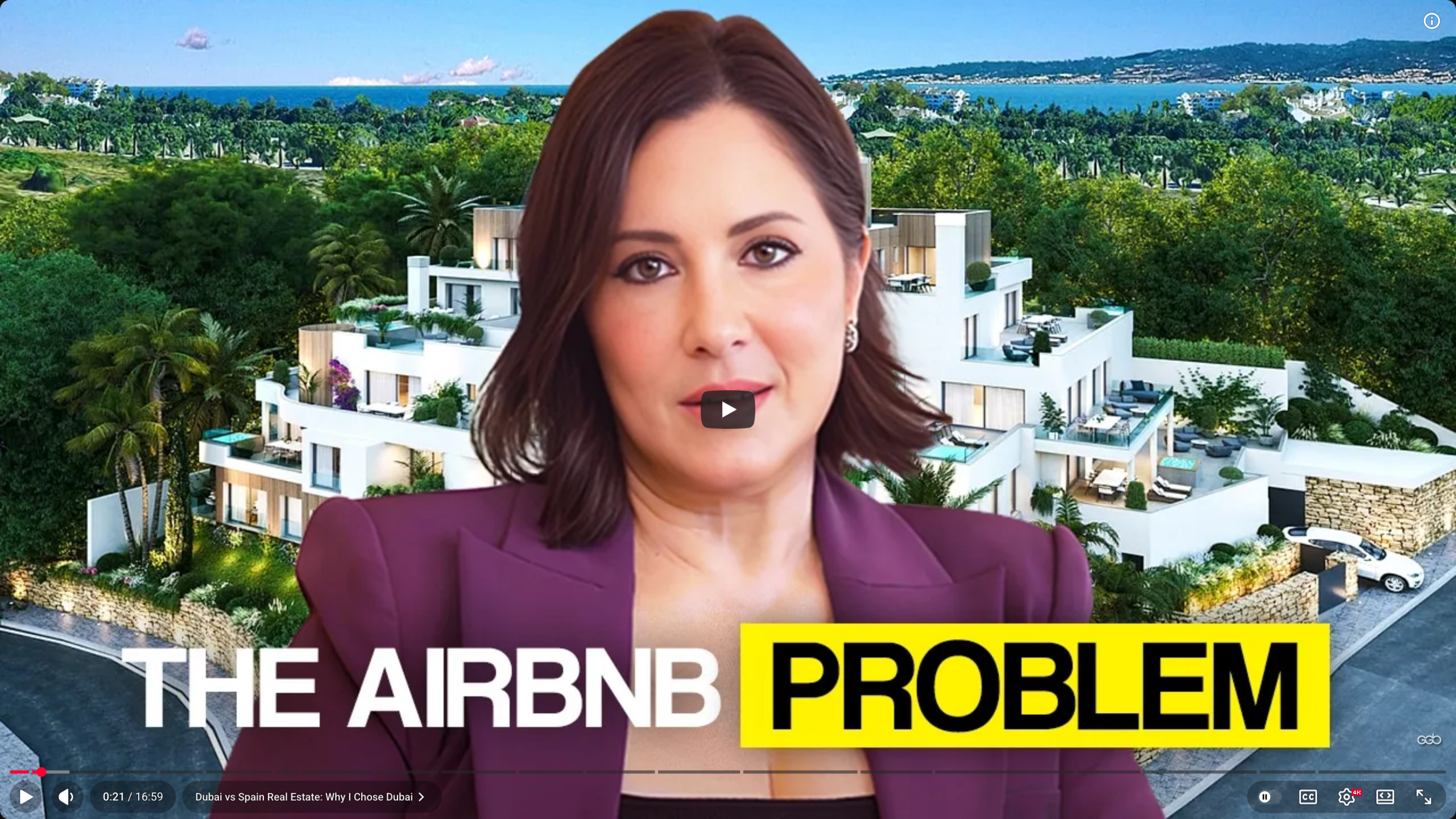
What if I told you the biggest risk to your Airbnb investment isn’t the property… it’s the government?And it’s the reason I spent almost 14 months researching Spain, seriously considered opening an office there, and ultimately decided to continue focusing on building my international real estate business in Dubai instead.Now, before anyone misunderstands me, this isn’t a video criticizing Spain. I actually love Spain. I love Marbella. I love Estepona. I love the Costa del Sol. And I enjoyed my time there. It’s a stunning place.
This is about something much bigger.
Because over the past few years, we’ve watched city after city begin restricting short-term rentals:
- Barcelona
- New York
- Amsterdam
- Toronto
- Vancouver
- Parts of California
And when Barcelona announced plans to phase out tourist apartment licenses over the coming years, it made me realize something:
Most investors are asking the wrong question.
They’re asking, “Is this a good apartment?”
When the better question is:
“Is this the right country to invest in over the next ten years?”
Because here’s what I’ve learned after working with international investors every single week:
You’re not just investing in real estate. You’re investing in a government’s vision.
And by the end of this article, I’m going to show you the framework I now use before recommending any international market to my clients.
Why This Matters
If this is your first time here, welcome.
I work with international buyers investing in Dubai, and I also help clients buy and sell in Coastal California, including La Jolla, Del Mar, and Coronado.
Every week I speak with people from the United States, Canada, the UK, and Europe who are asking the same question:
“Where should I invest internationally?”
But what’s interesting is that almost nobody starts with the right question.
They usually ask:
- What’s the hottest project?
- What’s going to appreciate the fastest?
- Where can I Airbnb?
Those are important questions, but they’re not the first questions you should ask.
Because if government policy changes, everything else can change with it.
And that’s exactly what we’re seeing happen around the world.
Why I Almost Built My Business Somewhere Else
A lot of people assume that because I help clients invest in Dubai, I must have always believed Dubai was the only obvious choice.
The truth is, I almost built my business somewhere else.
For nearly fourteen months, I was deeply researching southern Spain. In fact, I moved there to immerse myself in that real estate market and fully understand it so I could help guide my global real estate investors.
Not casually. Seriously.
I flew there. I spent time there. I met with developers, real estate agents, lawyers, and property managers.
I looked at:
- Marbella
- Estepona
- Benahavís
- Málaga
I wanted to know if this was a market I could confidently recommend to my clients.
And honestly, I fell in love with it.
The lifestyle is incredible. Beautiful beaches. Amazing food. Walkable cities. Fantastic weather. Warm people.
If you’ve ever been to southern Spain, you know exactly what I’m talking about.
I completely understood why so many Americans, Canadians, and Europeans dream about owning property there.
But then something started happening.
The conversations slowly changed.
Instead of asking, “Which property should I buy?”, people were asking:
- What happens if the regulations change?
- What if I lose my tourist license?
- What if my city changes the rules?
- What happens if I can’t Airbnb anymore?
And I noticed something else.
People weren’t just evaluating the investment. They were trying to predict politicians.
That’s a completely different type of investment.
I remember thinking:
If I recommend this market today, can I confidently tell my clients what the rules will look like five years from now?
And I couldn’t.
Not because Spain isn’t beautiful. Not because people can’t make money there. Because they absolutely can.
But I couldn’t confidently predict the direction of the regulatory environment.
That realization completely changed how I evaluate international real estate.
Today, before I look at a floor plan, before I compare prices, and before I compare rental yields, I ask a completely different question:
What direction is this government moving?
Because governments don’t just regulate real estate. They shape it.
The Question Every Investor Should Ask
Watch the full conversation on YouTube: Is Airbnb Investing Dead? The Dubai Connect episode.
Today, when a client calls me from California, New York, London, or Toronto, they’re often expecting me to tell them about the hottest new launch.
Instead, I usually ask them one question:
“Tell me what you’re trying to accomplish.”
Because buying a vacation home is completely different than building long-term wealth.
Buying for Airbnb is completely different than buying for appreciation.
Buying for retirement is completely different than buying something you’ll sell before completion.
The right investment always starts with the right strategy, not the right property.
The Moment My Thinking Changed
There was one conversation that completely changed the way I think about international real estate.
Years ago, on The Dubai Connect Podcast, I interviewed Dr. Mahmoud AlBurai from the Dubai Land Department.
If you’ve watched my podcast before, you know I love asking the questions that international buyers are actually thinking, but are sometimes afraid to ask.
So I asked him something very simple:
“What happens if my tenant refuses to leave?”
If you’re from the United States, Canada, or parts of Europe, you probably understand why I asked that.
We’ve all seen the headlines.
Landlords waiting months, sometimes more than a year, trying to regain possession of their own property.
Legal battles. Court costs. Lost rental income. Stress.
Whether those situations are common or rare doesn’t really matter.
Because investors don’t just think about probability. We think about possibility.
We ask ourselves:
“What’s the worst-case scenario?”
I’ll never forget Dr. Mahmoud’s response.
He smiled and essentially explained that Dubai has a structured legal framework with clear contracts, clear procedures, a dedicated Rental Disputes Center, and defined processes for resolving issues.
And what struck me wasn’t that Dubai was claiming perfection.
It was something much more important:
Predictability.
As an investor, predictability has value.
Because uncertainty always has a cost.
The Los Angeles Story
Around that same time, there was a story out of Los Angeles that really caught my attention.
An Airbnb guest refused to leave the property.
What started as a short-term stay turned into a complicated legal situation.
The homeowner couldn’t simply walk in and change the locks. Instead, they found themselves dealing with a legal process over possession of their own property.
Again, this isn’t about criticizing one city. Every legal system has its own rules.
But stories like that force investors to ask difficult questions.
Not just:
“How much money can I make?”
But:
“How protected am I if something goes wrong?”
And I think that’s a much smarter question.
Because real estate investing isn’t just about maximizing returns. It’s about managing risk.
The Framework I Use Today
That conversation changed something for me.
Today, I don’t compare apartments first.
I compare governments.
I compare long-term vision.
I compare whether a city is attracting people or losing them.
Whether businesses are moving in or moving out.
Whether infrastructure is expanding or standing still.
Whether tourism is growing or declining.
Whether regulations are becoming clearer or more restrictive.
Because here’s the truth:
The apartment can stay exactly the same while the investment changes overnight simply because the rules changed.
Think about that.
The kitchen didn’t change. The view didn’t change. The location didn’t change.
But one government decision can completely change the economics of owning that property.
That’s why I believe one of the biggest mistakes investors make is spending months comparing marble countertops without spending a single afternoon understanding the country they’re investing in.
Dubai Didn’t Just Build Buildings, It Built Demand
So that naturally raises the next question:
Why has Dubai become one of the world’s most closely watched destinations for international property investors?
Is it simply because of its tax environment?
Is it because of the skyline?
Or is something much bigger happening beneath the surface?
Because in my opinion, Dubai didn’t become successful by building skyscrapers.
It became successful by building demand.
People look at Dubai and they see beautiful skyscrapers, luxury apartments, five-star hotels, and waterfront communities.
But that’s not what I see.
I see demand.
Because buildings by themselves don’t create successful investments.
People do.
People are coming here for:
- Business
- Conferences
- Exhibitions
- Shopping
- Healthcare
- Sporting events
- Family vacations
- Employment opportunities
- Entrepreneurship and business setup
Every one of those people needs somewhere to stay.
Whether it’s for three nights, three months, or three years.
That’s demand.
And demand is what ultimately supports real estate.
Follow the Infrastructure, Not the Hype
One lesson I’ve learned after years in international real estate is this:
The smartest investors don’t follow the buildings. They follow the infrastructure.
Because infrastructure often comes before appreciation.
Think about what Dubai has been doing:
- Expanding airports
- Expanding the Metro
- Creating new master-planned communities
- Developing Expo City into a permanent business and innovation district
- Building new waterfront destinations
- Attracting multinational companies
- Hosting global conferences and exhibitions
- Continuing to expand its tourism ecosystem
None of those projects exist in isolation.
They’re connected.
They’re all part of one long-term vision.
And when I look at a market, that’s what I want to understand.
Not just where prices are today, but where demand is likely to come from over the next ten years.
This Is Why I Ask Different Questions
When a client calls me and says, “GG, what’s the best project?”, that’s not where our conversation starts.
Instead, I ask questions like:
- Are you trying to build wealth?
- Do you want monthly income?
- Will you use the property yourself?
- Do you want to retire here one day?
- Are you primarily looking for appreciation?
Because if your goal is Airbnb or short-term rentals, I’m looking at completely different locations than if your goal is a long-term family tenant.
For short-term rentals, I want to know:
- Can visitors easily reach Downtown Dubai?
- Is there convenient Metro access?
- How close is the airport?
- How close is the Exhibition Center?
- How close is Expo City?
- Can guests walk to restaurants and amenities?
- What gives a traveler a reason to choose this property over thousands of others?
That’s a completely different investment analysis.
And honestly, that’s why I believe buying internationally isn’t about finding the “best” project.
It’s about finding the right project for your strategy.
Managing a Dubai Property From Overseas
One of my favorite episodes of The Dubai Connect Podcast was with the CEO of GuestReady.
Because one concern I hear all the time is:
“GG, I live in California. How am I supposed to manage an Airbnb in Dubai?”
It’s a fair question.
Years ago, that would have been a major obstacle.
Today, it’s much more manageable.
Professional management companies can coordinate guest communication, cleaning, maintenance, pricing, and day-to-day operations.
That doesn’t mean short-term rentals are passive investments. They’re still businesses.
But it does mean you don’t necessarily have to live in Dubai to own and manage an investment property there.
This Isn’t Really About Airbnb
Here’s what’s interesting.
This article isn’t really about Airbnb.
Airbnb was simply the headline.
The real story is much bigger.
It’s about understanding why one city may be becoming more restrictive while another is investing heavily into attracting residents, businesses, tourists, and capital.
Because those decisions shape the future of a real estate market long before they show up in property prices.
And that’s exactly why I spend so much time studying governments, infrastructure, and long-term planning, not just launch brochures.
The Biggest Lesson I Learned
After spending nearly fourteen months researching Spain, interviewing government officials, developers, attorneys, mortgage experts, and property managers, and helping clients from all over the world invest internationally, I came to one conclusion:
The best investors don’t simply buy where prices are rising. They buy where the long-term vision makes sense.
Because every city has beautiful apartments.
Every city has luxury buildings.
Every city has marketing brochures promising incredible returns.
But not every city has a government intentionally building an environment designed to attract talent, businesses, entrepreneurs, tourists, and investment.
That’s what I look for today.
Not perfection.
Direction.
Don’t Fall in Love With the Property
One of the biggest mistakes I see investors make is falling in love with a property before they’ve fallen in love with the market.
They’ll spend weeks comparing finishes, kitchens, bathrooms, balcony views, and amenities.
But they’ll spend almost no time asking:
- Where is this city’s population headed?
- What industries are growing here?
- Is tourism increasing?
- Are global companies opening offices here?
- What infrastructure is being built?
- Is this government making it easier or harder for investors?
Because if you buy into the wrong market, even the perfect apartment may never become the investment you hoped for.
On the other hand, a well-located property in a city with strong long-term fundamentals can continue creating opportunities long after the excitement of launch day has faded.
Why I Chose Dubai
People often ask me:
“GG, do you think Dubai is the best place in the world to invest?”
And my answer is always the same.
I don’t believe there’s one perfect market for everyone.
The right investment depends on your goals, your timeline, your risk tolerance, and your overall strategy.
But I can tell you why I chose to build my international business here.
Because when I step back and look at the bigger picture, I see:
- Consistency
- Planning
- Infrastructure
- Long-term thinking
- Investment in transportation
- Investment in tourism
- Investment in innovation
- Investment in quality of life
That doesn’t guarantee every investment succeeds.
Nothing can.
But it gives me confidence in the direction of the market.
And as someone whose reputation depends on the advice I give my clients, that matters.
GG’s Perspective
If there’s one thing I’d love for you to take away from today’s discussion, it’s this:
Don’t just research the property. Research the country’s vision.
Because governments shape markets.
Infrastructure creates demand.
Demand drives real estate.
And over time, those bigger forces often matter far more than the color of the kitchen cabinets or whether the apartment has one extra balcony.
That’s become my framework.
It’s how I evaluate opportunities.
It’s how I advise my clients.
And honestly, it’s one of the biggest lessons I’ve learned throughout my career.
Final Thoughts
If you found this article helpful, I’d really appreciate you subscribing to The Dubai Connect Podcast.
Every week, my goal is to help you become a smarter global real estate investor by bringing you conversations with government leaders, economists, developers, attorneys, mortgage experts, and professionals who are actually shaping these markets, not just talking about them.
And I’d love to hear your thoughts:
Do you think more cities will continue restricting short-term rentals over the next decade, or do you think we’ll eventually see that trend reverse?
If you’re considering investing in Dubai, or you’re simply trying to understand whether it fits your long-term goals, explore our additional educational resources covering financing, legal considerations, off-plan investing, and choosing the right investment strategy.
Until next time, I’m Ghada “GG” Benitez.
Thank you for spending your time with me.
The best investors don’t chase the hottest property. They invest where the future is being built.
About the Author
Ghada “GG” Benitez works with international buyers investing in Dubai and also helps clients buy and sell real estate in Coastal California, including La Jolla, Del Mar, and Coronado. Through The Dubai Connect Podcast, she shares insights from developers, government leaders, economists, legal professionals, mortgage experts, and other industry specialists to help global investors make more informed real estate decisions.